Hi Prof. Stephenson, hi Prof. Taylor. Which of these do you think I should work on next?
Do the questions below fit what I’m trying to achieve? I’d appreciate your thoughts on where I need to be more specific and which tests would help most.
Completed retrospective experiment with a frozen evidence package. Targets are reanalysis grid cells, not station observations.
Public ERA5 via Open-Meteo, NASA POWER and NOAA OISST inputs. Author-held frozen evidence package with 4,320 metric rows, bootstrap/regime/physics/calibrated-weather tables and source audit; available on request. Independent recount passed 3,520 primary MAE/RMSE rows. Checkpoint revisions pinned; CPU experiments; no checkpoint retraining.
Use quality-controlled stations, versioned issue-time inputs and a new post-freeze period, with TimesFM 2.5 retained as a reference.
Completed conditional downscaling experiments and driver-sensitivity analysis. Forecast skill was not tested.
Public CHIRPS v2 and NOAA GSOD inputs. The author holds acquisition scripts/hashes, arrays, checkpoints, station QC, predictions and score tables; archive available on request. Not re-executed for this draft.
Test an actual coarse driver with verified release times, development-only bias correction and independent gauges.
Three completed exploratory experiments. Results are relative to CHIRPS; no independent gauge verification was performed.
Public CHIRPS through ClimateSERV. Companion author archive contains raw API responses, geometry/coordinates, hashes, features/models, checkpoints, predictions, scores and validation records. Available on request, not rerun for this draft.
Use real publication vintages and gauges, separate model class from pooling in calibration tests, and match update budgets in island-held-out transfer tests.
Completed retrospective reconstruction at three USCRN stations, with ten held-out station-season blocks and 150 main fits.
Public observations already used; reproducibility archive held by the author. NOAA U.S. Climate Reference Network hourly files. Protocol/configuration hashes, teacher and field weights, 480 training snapshots, audit grids, scores and control outputs are available on request.
Develop an oracle-free safeguard, test fresh windows and evaluate operators expensive enough to justify learned replacement.
Proposed formulation; completed propositions and synthetic experiment. No atmospheric experiment has run.
Synthetic data available in the research package; atmospheric archive not secured. No external meteorological input was used. Solver, closure networks, protocol, hashes, seeds and result tables are held in the research package and available on request.
Resolve optimisation-budget and two-dimensional synthetic tests, then secure and audit suitable meteorological events before an atmospheric evaluation.
Completed two-checkpoint zero-shot inference experiment. The 209M checkpoint and operational forecasting remain untested.
Public CHIRPS, author-held two-series archive identified by hash; acquisition code, ridge selections, forecast arrays, scored windows, bootstrap draws and recount logs available on request. Timestral checkpoints remain under Mistral licence.
Run the prespecified 209M comparison, recover and pin checkpoint revisions, then evaluate versioned near-real-time inputs against independent gauges.
Completed retrospective six-cell pilot with a primary comparison fixed before outcomes were inspected.
Public NASA POWER data already used; full research package archived. NASA POWER daily API v2.10.1, reported MERRA-2/POWER meteorological sources. API responses, feature code, models/calibrations, 576 metric rows, bootstrap draws and sensitivities are held in the author's archive and available on request.
Use independently audited gauges, release-time inputs and a fresh evaluation period with whole-event and whole-island holdouts.
Completed derivations, numerical checks and a manufactured 12-cell test. Atmospheric reconstruction and evaluation are proposed and unexecuted.
Analytic and manufactured-code evidence exists; no atmospheric dataset was used for this paper. ERA5 is a proposed background, not completed atmospheric evidence in this manuscript. Analytic-check script, 12-cell code, seed, training/held-out fields and report are held in the programme repository and available on request.
Choose an independent nature run for Stage 1, fit a fair constant-conductance comparator and audit independent atmospheric observations before Stage 2.
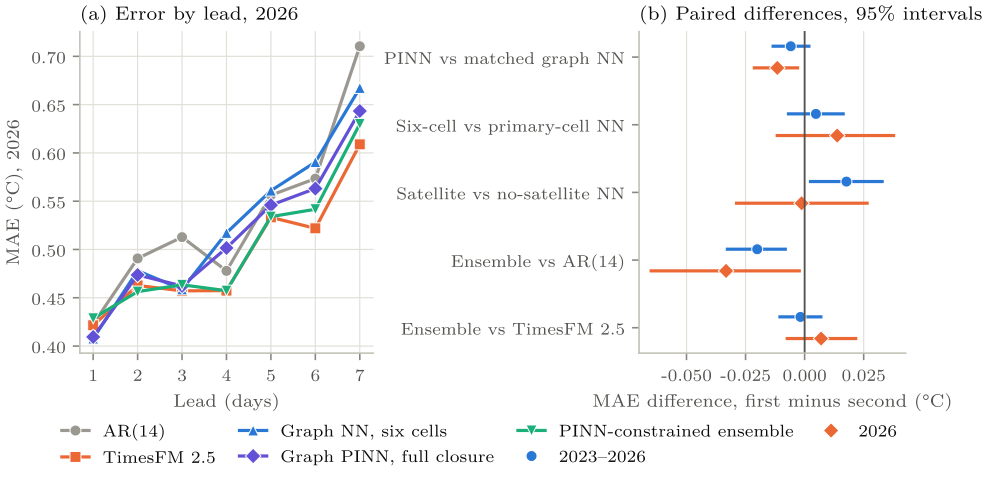
I wanted to see whether satellite information and a small set of heat-exchange equations could help predict temperature seven days ahead. I tested these additions at three Jamaican grid cells and compared them with simple forecasts and pretrained forecasting models.
The physical rule helped its matched neural network in the 2026 subset. Across the full period, the evidence was less clear. Extra satellite inputs and more neighbouring cells did not give a reliable improvement. The test used gridded estimates of temperature, rather than measurements from local weather stations.
I used this paper to work through how to put physical equations into the network and check whether they actually help.
Have I chosen a sensible physical rule to start with, or am I leaving out something that matters?
Would you narrow this to one location and station record before I add more equations?
Targets are ERA5-derived grid cells, not station observations or named-town microclimates.
Finalised reanalysis inputs and imposed lags do not reproduce publication vintages or operational availability.
Earlier rounds inspected evaluation years; bootstrap intervals are descriptive and omit retraining/search uncertainty.
Radiation requests yield only three distinct histories, and 61 POWER tail days are missing. Offshore SST and context cells do not resolve the island's terrain.
Symmetric exchange conserves unweighted anomalies under equal implicit capacities; it is not a measured atmospheric energy budget.
The reduced closure omits advection, humidity, longwave and turbulent fluxes; reference recentring also drops a mean-level source.
Weather archive has only 16 origins, a fixed-lead convention and post hoc calibration on eight scoring origins.
Foundation-model pretraining overlap is unaudited.
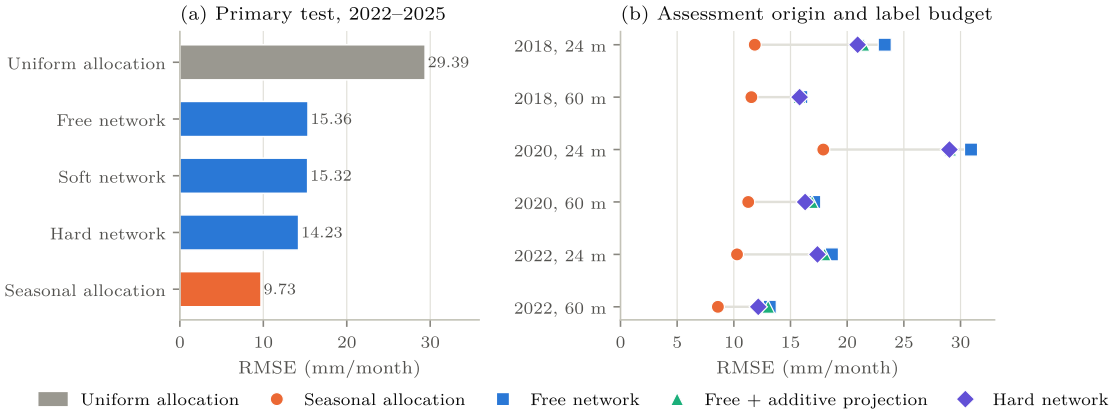
I wanted to see whether a rainfall model could get the total right and still put the rain in the wrong places. I used monthly CHIRPS rainfall estimates for Jamaica and asked a neural network to divide larger-area totals among smaller areas.
I compared versions that had to match the supplied total with versions that did not, and with a simple method based on the usual seasonal pattern. Matching the total helped the network, but the seasonal method had lower error against CHIRPS. When the supplied total was wrong, the detailed map carried part of that error.
This helped me think through which physical checks improve the model and which checks only confirm that the numbers add up.
Do you think this is a good way to separate a correct rainfall total from a correct local rainfall map?
Should I focus next on local weather station data, or do I need to make the research question more specific?
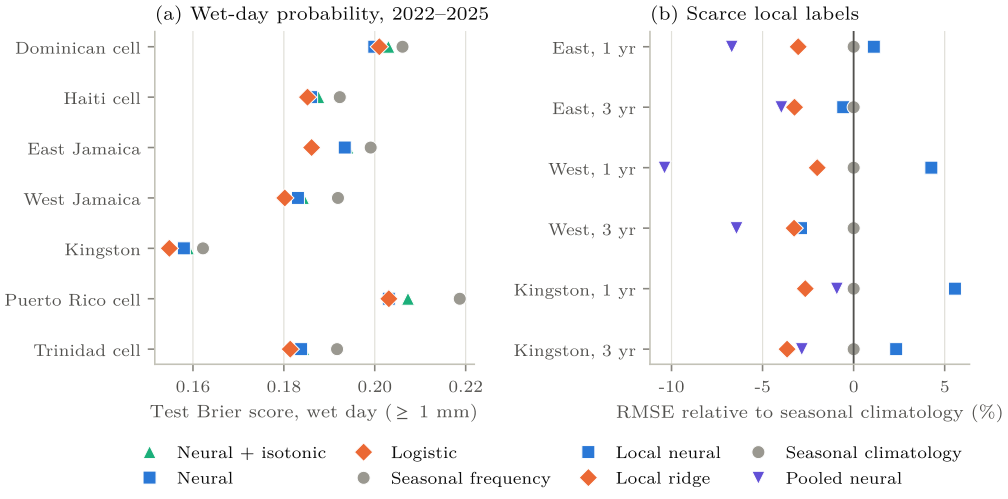
I wanted to test what happens when the data I need are late, limited or different from the data used to adjust the model. I ran three rainfall tests using CHIRPS: delayed inputs, corrections fitted on an earlier period, and training with fewer local records.
At the Jamaica mean, the neural model’s advantage over a seasonal estimate was absent with seven days of added delay. Earlier corrections made the later neural wet-day scores worse at all seven tested cells. Sharing records helped the local neural models, but a simpler local model still performed better at Kingston.
This came from the data-access problem I keep running into. I wanted to know which limits I need to deal with before making the model more complicated.
Are these the right data problems to investigate for the Caribbean?
Should I keep these tests together, or would one more specific question make a stronger paper?
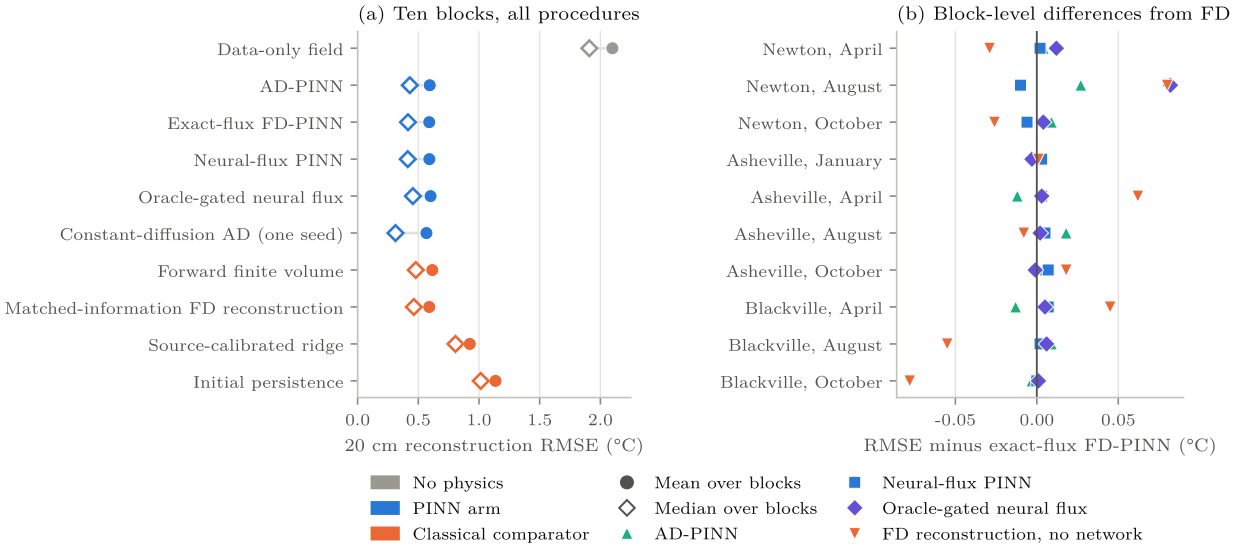
I wanted to see whether a small neural network could replace a heat-flow calculation and still recover soil temperature correctly. I used records from three U.S. Climate Reference Network stations, hid the temperature at 20 cm depth, and tried to recover it from the other measurements.
The neural replacement did not improve the result. An extra check kept its local calculation error within a set limit, but the final temperature estimates had slightly higher mean error. A conventional numerical method matched the main exact-flux neural model at the reported precision.
This helped me separate getting one calculation right from getting the whole reconstructed temperature right.
Does this add up to a useful test of the emulator idea?
Would you keep this negative result as a paper, or use it to guide a more difficult test where a learned replacement might be useful?
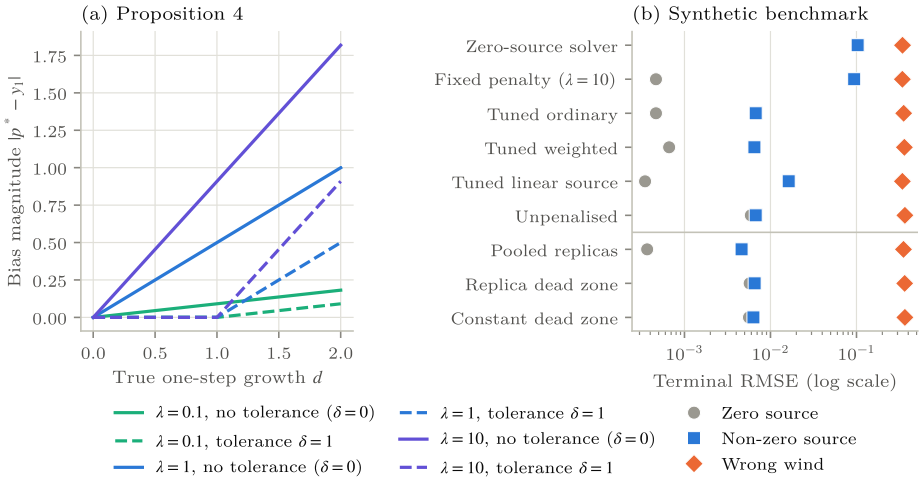
I wanted the model to separate rain moving across a map from rain growing or fading. I built a small one-dimensional simulation where I knew how the rain moved and changed, then tested a model that could learn the missing growth term.
Learning that term helped when the simulated system had growth. My more complicated rules for learning the growth term did not beat a simpler method given the same information. The transfers could still balance even when the movement was wrong. I have not run an atmospheric experiment for this paper.
This was a way for me to test one piece of the formulation before combining it with the rest of the physics.
Am I separating movement, growth and decay in a sensible way?
Would you simplify this further before moving to a two-dimensional test and weather data?
No meteorological data were used and no atmospheric experiment has run.
The manufactured experiment is one-dimensional and periodic, and shares transport and reaction structure between simulator and forecaster.
The primary weighted experiment gave the weighted learner extra source-sensitive information; the follow-up comparison corrects this and favours pooling.
Dead-zone follow-ups act in coefficient space; the full atmospheric dimensional residual-budget rule remains untested.
Every neural fit reached its iteration cap, so comparisons concern fixed budgets rather than converged optima.
No radar retrieval, real boundaries, convection, water storage, issue-time latency, probabilistic calibration or generative nowcaster was tested.
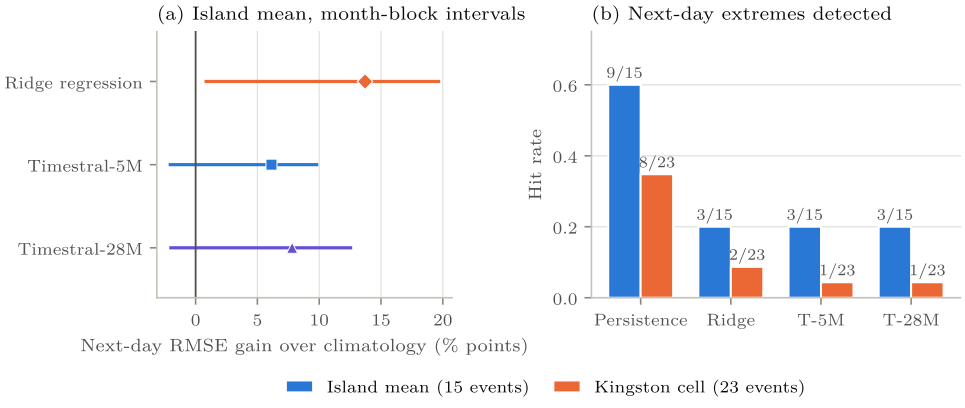
I wanted to check whether two pretrained Timestral models could do better than simple rainfall forecasts when they all received the same Jamaican rainfall history. I tested the models on past gridded rainfall estimates, without retraining them. I compared their predictions of the total rain over the next one, three and seven days.
Timestral did better on the average size of next-day errors. The simpler models did better when large misses received a stronger penalty, and using yesterday’s rain detected more very wet days. With a 45-day delay in the rainfall input, the usual seasonal estimate had the lowest squared-error score everywhere tested.
This helped me see that the model I choose depends on what I need it to get right, especially the heavy-rain days.
Which result should matter most for the next test: everyday rainfall, heavy events or the effect of late data?
Does this comparison help the framework, or would you take it in another direction?
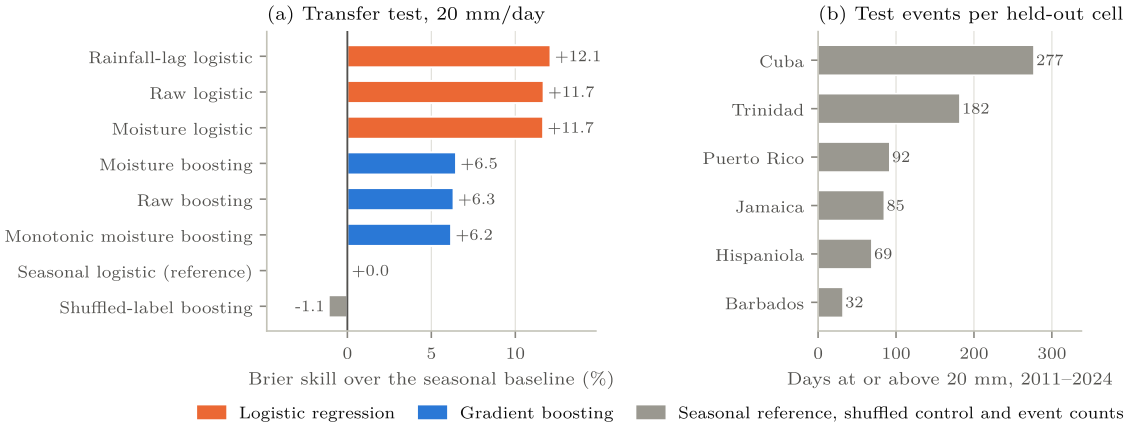
I wanted to see whether turning temperature and dew point into moisture variables would help a rainfall model at a location it had not learned from. I used NASA POWER weather records at six selected Caribbean grid cells and left the target cell out of training and calibration.
The change gave no clear improvement. A simple model using the season and yesterday’s rainfall performed best. These were gridded weather records, so the result still needs a separate check against local rain gauges.
I used this test to understand whether adding a physically meaningful input helps on its own, before I add more of the physical equations.
Is this a useful comparison to keep as I refine the framework?
Would you focus next on local observations, a different physical variable or putting the equations directly into the model?
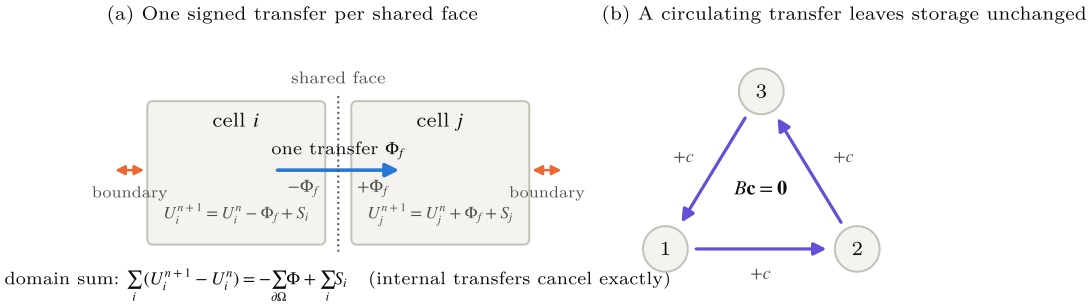
This is the paper where I tried to bring the formulation together. I split the system into small blocks and gave neighbouring blocks one shared record of what crosses their boundary. The aim is to stop one block from recording a transfer that the next block does not receive.
I worked through the equations and tested the accounting on a small, constructed 12-cell heat system. The transfers balance as intended, but a balanced record does not prove that the transfers are physically correct. I have not yet run the atmospheric reconstruction.
This is closest to the part I’m still trying to get fully clear: how the equations and deep learning models work together across space and time.
Does this formulation capture what I’m trying to achieve with the framework?
Which physical equations and boundary conditions should I get right first, and where do I need to be more specific?
No atmospheric data were used and no atmospheric reconstruction has run.
The manufactured chain has no cycles, noise, missing observations or unseen geometry.
Exact cancellation alone does not prove humidity positivity, stable atmospheric integration, physical flux accuracy or calibrated uncertainty.
The proposed first atmospheric class is hydrostatic at the background's resolved scale; fine output spacing does not establish sub-kilometre or convection-permitting skill.
Smoothing may use observations after an event; its skill cannot be presented as forecast skill.
Backward evaluation is not stable time reversal; diffusion inversion amplifies small-scale noise.
Independent atmospheric observation access and the Stage 1 simulation are still needed.
The fixed-conductance comparator in the manufactured test is untuned.
Your recommendation
Rainfall, crop decisions and flood-model verification
These studies combine real rainfall archives with explicit numerical and scenario assumptions. Independent local field data remain unavailable; the papers separate retrospective checks, manufactured model tests and future validation.
Crop-model diagnostics: real rainfall forcing, synthetic water-balance targets and explicit failure cases.
Trained rainfall models and satellite-input testing
Read the rainfall-model experiment or open its evidence dashboard. The neural models and calibrated satellite inputs were tested. The simpler linear model performed better; adding the tested imagery features worsened all paired selected neural results. These are revised-archive hindcasts, not an operational warning service.
Temperature transfer limits
Read the separate island-transfer study. The excluded-Barbados neural models perform worse than linear interpolation. These endpoint-known results do not establish unseen-island transfer or operational forecasting.
Local Endpoint-Constrained Residual Calibration compares separately trained models for Jamaica, Barbados and Puerto Rico. The empirical correction did not consistently improve held-out errors; it is not a discovered physical law.