2.1 Introduction
2.1.1 The problem
Explaining why a particular Caribbean storm produced the rainfall it did runs into the same obstacle every time. Rain gauges record what fell at a handful of points. Satellites record radiances that have to be converted into rain rates, cloud properties or temperatures. Reanalyses such as ERA5 provide a complete and dynamically balanced atmosphere, but one produced by a forecast model pulled towards whichever observations happened to be available (Hersbach et al., 2020). Over a small mountainous island surrounded by sea these sources disagree, and more than one atmospheric history can be consistent with all of them.
Machine learning has made it cheap to produce detailed fields. A coarse rainfall map can be refined to a one-kilometre grid in seconds. What that refinement adds in information, as opposed to in pixels, is a separate question, and it is the question this thesis is concerned with. A reconstructed rainfall field can be spatially detailed and still say little about the circulation and moisture supply that produced it.
2.1.2 Research question
I treat retrospective reconstruction of moisture transport as the primary task. The research question is:
Under which combinations of observational coverage and large-scale driver error does physically specified coupling between local learned representations improve retrospective reconstruction of moisture transport and rainfall-relevant atmospheric structure over Caribbean island domains?
Moisture transport is the focus because it links the three-dimensional atmospheric state to regional rainfall through storage, convergence and exchange across boundaries. Rainfall observations constrain that system without determining its vertical circulation or humidity profile, and much of this chapter is about the gap between the quantity observed and the process inferred.
The framework I propose, D-LEGOS, represents interacting regions of space and time with local learned fields that exchange physically defined quantities with their neighbours. Local neural representations are already well developed (Jagtap & Karniadakis, 2020; Moseley et al., 2023; Dolean et al., 2024), and fitting a trajectory to observations under approximate physics is the core of variational data assimilation (Trémolet, 2006). What D-LEGOS adds is the test described in the chapter summary, not locality or physics-guided fitting as such.
2.1.3 Scope
Retrospective reconstruction is the organising task, and three adjacent problems inform it without being treated as interchangeable. Conservation-aware downscaling gives a restricted setting in which the effects of driver error and exact aggregation can be isolated. Learned weather models provide context for how atmospheric states are represented and where large-scale inputs might come from. Long-run climate emulators set the bar that any later claim about climate statistics or forced response would have to meet. A good reconstruction of a historical event says something about the relationship between circulation, moisture and rainfall under those conditions; it says nothing about how rainfall will change in a warmer climate. I keep forecasting and climate response as later extensions, each needing its own evidence.
2.1.4 How the review was conducted
This is a critical thematic review, not a systematic review or meta-analysis. I started from a curated reference library of roughly 170 documents assembled over the course of the doctorate, then ran targeted searches of publication databases and preprint servers along the closest physical, statistical and numerical lines of work. Search terms included "Caribbean moisture transport", "Caribbean low-level jet variability", "Jamaica CHIRPS gauge validation", "early-season Caribbean rainfall predictability", "hard-constrained downscaling", "imperfect model 4D-Var", "physics-informed domain decomposition" and "neural conservation laws". Where both a preprint and a journal version exist I cite the journal version; remaining preprints are marked in the references. The source draft identifies references that still require full-text checks; the synthesis remains provisional until those checks are recorded. Published corrections are cited alongside the original paper (Sobel et al., 2011, 2013; Geer, 2021, 2022).
2.1.5 Structure
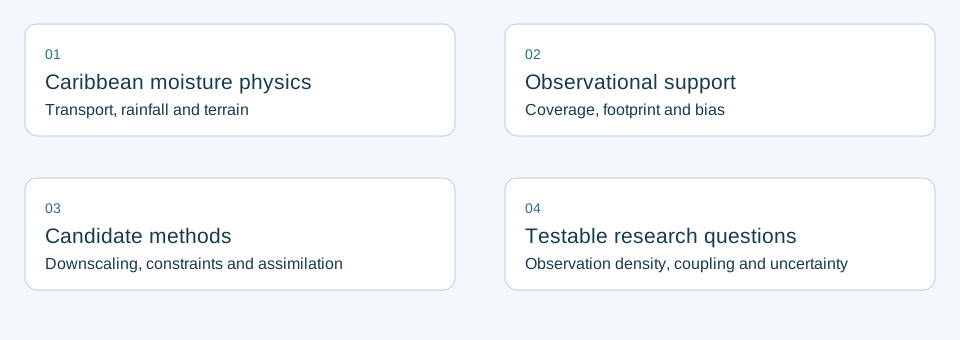
Section 2.2 sets out the Caribbean physical problem. Section 2.3 examines what the available observations and reference products actually measure. Sections 2.4 and 2.5 review learned downscaling and learned atmospheric models. Section 2.6 asks what it means for a learned model to respect physics, and Section 2.7 reviews the two lines of work closest to D-LEGOS: domain decomposition and data assimilation. Section 2.8 brings these together and identifies the gap. Figure 2.1 summarises the argument.
2.2 The Caribbean physical problem
2.2.1 Seasonal rainfall and its ocean connections
Across much of the Caribbean, including Jamaica, the rainy season has two peaks separated by a drier spell in mid-summer. Gamble and Curtis (2008) review the mechanisms behind this pattern and the uneven state of knowledge about them. Taylor et al. (2002) showed that the two halves of the season answer to different oceans: early-season rainfall is associated mainly with tropical North Atlantic sea-surface temperature anomalies, while the late season responds more to the equatorial Pacific and the gradient between the Pacific and Atlantic. Giannini et al. (2000) place interannual variability within the competing influences of ENSO and the Atlantic.
The practical consequence is simple. A model that learns one relation between sea-surface temperature and rainfall from all months pooled together is averaging over two different physical regimes. Seasonal conditioning is a requirement, not a refinement.
2.2.2 The Caribbean low-level jet and moisture supply
The Caribbean low-level jet is the most physically interpretable link between circulation and rainfall in the region. Using reanalyses for 1979–2001, Muñoz et al. (2008) identified winter and summer maxima in the jet near 925 hPa and connected the mid-summer rainfall minimum with enhanced moisture-flux divergence. Wang (2007) documents the jet's interannual variability and its links to the North Atlantic subtropical high and ENSO. Lagrangian analysis by Durán-Quesada et al. (2010) identifies the Caribbean Sea and tropical North Atlantic as the main moisture sources for Central American rainfall, and Gimeno et al. (2012) place such source attribution in a global context.
Together these studies show that the object worth reconstructing is a vertically structured transport field and its divergence, not a scalar jet index applied uniformly across the domain. Strengthened easterly flow can increase rainfall on a windward slope, suppress it in the lee of the same mountain and change little offshore. Muñoz et al. also illustrate a limit: a reanalysis budget diagnosis has dynamical structure but inherits the reanalysis system's errors, whereas an ocean–rainfall correlation is closer to the data but carries no mechanism. Neither alone pins down a causal chain.
The mid-summer drought literature adds caution about geography. Magaña et al. (1999) described the phenomenon over Mexico and Central America, and García-Franco et al. (2023) revisit the competing explanations for it. Their conclusions concern the mainland, and the timing and depth of the mid-summer minimum vary across islands. Campbell et al. (2021) show that projected rainfall and temperature changes differ between Caribbean subregions, which is a reason to keep geographical differences visible in evaluation as well as in training data.
2.2.3 A relationship that moves
Clarke et al. (2026) find that over 1979–2024 the link between absolute tropical North Atlantic sea-surface temperature and early-season rainfall weakens as atmospheric stability and circulation change. At first sight this contradicts Taylor et al. (2002). I read it differently. The two studies cover different periods and use different predictor definitions, and a relationship that holds within one thermal background can fade when the convective environment shifts. Clarke et al. is stronger evidence for representing the mechanisms through which the ocean influences convection (relative sea-surface temperature, stability, humidity and circulation) than for dropping ocean predictors. For this thesis the implication is that historical feature rankings are a poor guide to what will matter in a warmer regime, and reconstruction should be conditioned on circulation and stability.
2.2.4 Islands, terrain and effective resolution
Small islands are a hard geometry for any model. Land–sea contrast, surface heating and orographic lift operate at scales the driving model may barely represent. Sobel et al. (2011) compared satellite rainfall over tropical islands with the surrounding ocean and separated the effects of rainfall frequency, intensity and relief; their correction (Sobel et al., 2013) changed the statistics after invalid negative retrieval values were removed. The corrected evidence supports testing island–ocean and terrain contrasts directly. It does not support a universal island-size threshold for rainfall enhancement.
Jamaica makes the scale problem concrete. The island is roughly 235 km long and 80 km wide, which is about nine by three grid cells at ERA5's 0.25° spacing. Blue Mountain Peak rises to 2,256 m, high enough that the 850 hPa and 800 hPa surfaces intersect terrain in the east of the island. A grid cell labelled "Kingston" mixes sea, coastal plain and hillside, and its temperature is not a measurement of Kingston's air temperature. Jury (2020) shows that the picture of Caribbean hydroclimate change itself depends on the resolution of the satellite and reanalysis products used.
This is the distinction between grid spacing and effective resolution. Grid spacing describes how a field is stored. Effective resolution is the scale at which the field carries real information, and it depends on the observations, the model dynamics, the interpolation method and the evaluation target. Refining a coarse rainfall field to a one-kilometre grid does not create one-kilometre information. If the only measurement is an area average, many fine-scale fields share that average; terrain, additional observations and justified physics can narrow the options, but interpolation alone cannot choose between them.
2.2.5 Regional climate modelling
Dynamical regional modelling is the established response to the scale problem, and Caribbean work with it is extensive. PRECIS experiments produced early regional projections (Campbell et al., 2011) and quantified their uncertainty (Centella et al., 2008). Centella-Artola et al. (2015) showed that results depend on domain size, and Martínez-Castro et al. (2016) showed sensitivity to the convection scheme in RegCM. Taylor et al. (2018) compare Caribbean climates at 1.5 °C and 2.0 °C of global warming, and Karmalkar et al. (2013) review observed and projected changes for the islands. Stephenson et al. (2014) document observed changes in temperature and precipitation extremes over 1961–2010, with warming of temperature extremes more spatially consistent than changes in rainfall extremes.
These studies prevent "the regional climate model" from being treated as a single benchmark. Any comparison has to state which model, configuration, driving model and forcing it refers to. CORDEX coordinates regional experiments and evaluation protocols (Giorgi et al., 2009; WCRP CORDEX, 2024), but it is a framework, not a solver. For D-LEGOS, the domain-size result matters most: a Jamaica-only land mask may be convenient for scoring rainfall but is not an adequate dynamical domain. The domain must include enough ocean and surrounding atmosphere to represent inflow, and domain size should be tested before architectural complexity is added.
2.2.6 Hazards: events versus climate
High-resolution modelling of Caribbean tropical cyclones (Dullaart et al., 2024), work on changing shear and sea-surface temperature (Hibbert et al., 2023) and analysis of rapid intensification (Balaguru et al., 2018) address related but different quantities. Estimating the intensity of an observed storm, predicting its evolution and describing how cyclone statistics shift under forcing are three different conditional questions with three different validation requirements.
Ramseyer and Miller (2023) widen the hazard question. Their evaporative-demand definition of flash drought finds rapid drying with recurring subregional structure, which shows that rainfall alone cannot characterise every relevant hydroclimatic hazard. This supports reconstructing a multivariable atmospheric state. It does not require the first D-LEGOS experiments to address drought and hurricanes together, and I do not attempt that. A single storm such as Hurricane Beryl (July 2024) can test whether a reconstruction recovers the moisture convergence behind its rainfall; it cannot say anything about return periods. Event selection is set out in Chapter 3.
Table 2.1. Regional evidence and its limits for atmospheric reconstruction
| Study | Evidence | Main finding | Limit for this thesis |
|---|---|---|---|
| Taylor et al. (2002) | Seasonally separated rainfall vs ocean variability | Atlantic and Pacific associations differ between early and late seasons | Associations need a circulation pathway to be interpreted |
| Muñoz et al. (2008); Wang (2007) | Reanalysis diagnosis of the CLLJ | Jet structure and moisture-flux divergence link circulation to rainfall seasonality | Diagnoses inherit reanalysis error |
| Durán-Quesada et al. (2010) | Lagrangian moisture-source attribution | Caribbean Sea and tropical North Atlantic are major sources | Mainland target; island transfer untested |
| Clarke et al. (2026) | Early-season rainfall, 1979–2024 | Absolute tropical Atlantic SST loses predictive value as the background changes | Says which predictors weaken, not which reconstructed state is correct |
| Sobel et al. (2011, 2013) | Satellite island–ocean contrasts, corrected | Relief, frequency and intensity need separate comparison | No universal island-size threshold |
| Centella-Artola et al. (2015) | PRECIS domain-size experiments | Regional results depend on domain extent | Domain choice is part of the design, not preprocessing |
| Campbell et al. (2021); Taylor et al. (2018) | Projections at global warming levels | Subregions differ in projected change | Conditional simulations, not historical observations |
| Ramseyer & Miller (2023) | Evaporative-demand flash drought | Rapid drying has subregional structure | Drought definitions do not transfer to heavy-rain reconstruction |
2.3 Observations and reference products
2.3.1 Every product is already an inference
CHIRPS combines infrared satellite information, climatology and station data into a long precipitation record (Funk et al., 2015). That makes it valuable for regional analysis, including work on persistence and trends in Jamaican rainfall (Avalon Cullen & Al Suhili, 2023), but it also makes it an estimate rather than a measurement at each grid point. If a model is trained on CHIRPS and checked against gauges that contributed to CHIRPS, training and evaluation share information. The same gauge cannot be part of the target and an independent check.
Product versions matter as much as product names. CHIRPS version 3 updates the climatology and station inputs relative to version 2 while keeping a 0.05° grid (Funk et al., 2026), so the 2015 paper documents version 2 only. IMERG's Early, Late and Final runs differ in latency and in the information they use (NASA GPM Science Team, 2023). Training on the Final product is legitimate for reconstruction but would overstate what is available for an operational forecast. A model can also appear to improve simply because its reference product changed. I therefore freeze dataset identifiers, versions, acquisition dates and processing steps, and test whether conclusions survive a reasonable change of reference product.
Centella-Artola et al. (2020) evaluated sixteen gridded precipitation datasets against Caribbean gauge observations. Their comparison answers a question no single-product study can: whether apparent regional features depend on the estimation system. It also shows that product rankings depend on the gauge network, the accumulation period and the spatial support used, so a ranking is conditional rather than universal. Where products disagree, the disagreement is information about uncertainty and should be examined by season and terrain rather than averaged away.
2.3.2 The observing network over the study domain
The case for this thesis rests on observations being sparse, so the sparsity has to be stated. Table 2.2 summarises the network over the proposed domain.
Table 2.2. Observing network over the study domain — counts and coverage not yet specified in the source draft
| Observation type | Number / coverage | Variables | Temporal resolution | Feeds CHIRPS / ERA5? | Source |
|---|---|---|---|---|---|
| Rain gauges (Jamaica) | Not specified | Precipitation | Not specified | Not specified | Not specified |
| Synoptic / automatic weather stations | Not specified | T, q, wind, pressure | Not specified | Not specified | Not specified |
| Radiosonde sites within domain | Not specified | Vertical profiles | Not specified | Not specified | Not specified |
| Weather radar | Not specified | Reflectivity / rain rate | Not specified | Not specified | Not specified |
| Satellite precipitation (IMERG, CHIRPS) | Gridded | Precipitation | Not specified | — | Funk et al. (2015, 2026); NASA (2023) |
| Offshore (buoys, ships) | Not specified | Not specified | Not specified | Not specified | Not specified |
The source does not yet establish the network counts, offshore profile coverage or overlap with CHIRPS inputs. These gaps prevent a quantitative claim about observational sparsity.
2.3.3 Satellite retrievals and observation operators
Satellites do not observe most of the variables an atmospheric model evolves. Infrared cloud-top information, microwave radiances, optical reflectance and thermal emission each relate to rainfall, humidity and temperature in a different way. The retrieval literature, including deep-learning passive-microwave retrievals (Rahimi et al., 2022), conditional generative estimation from GOES-16 imagery (Hayatbini et al., 2019) and neural bias correction of satellite rainfall (Tao et al., 2016), shows that converting what an instrument sees into a geophysical variable is a modelling problem in its own right. Its uncertainty does not vanish when the retrieved product is fed into another model.
Shared units hide differences in what is measured. Land-surface skin temperature, near-surface air temperature and sea-surface temperature are all in kelvin but describe different things at different heights (Afshari et al., 2023; White et al., 2024; Xu et al., 2020). Sea level has units of length and reflects both mass and thermal expansion; in the Caribbean, Maitland et al. (2024) find a shift from temperature-driven to mass-driven sea-level rise. A coupling scheme that treats all of these as a generic "ocean feature" loses the physics needed to test its contribution.
Earth-observation embeddings such as AlphaEarth Foundations (Brown et al., 2025) and Prithvi-EO-2.0 (Szwarcman et al., 2024) offer reusable surface information. They also create a leakage risk: a model may appear to predict temperature from embeddings partly because temperature-related products entered pretraining. The useful test is whether an embedding adds information beyond the climate variables, dates and location already available to a baseline, with its pretraining inputs and dates audited against the evaluation period.
The general principle is that an observation relates to the atmospheric state through an operator that encodes footprint, vertical sensitivity, time window and retrieval assumptions, together with an error that includes representation as well as measurement error. Chapter 3 makes this operator explicit.
2.3.4 Reanalysis as a reference
ERA5 combines a forecast model with four-dimensional variational assimilation to estimate the evolving atmosphere (Hersbach et al., 2020). It provides consistent multivariable three-dimensional fields at about 31 km model resolution, distributed hourly on a 0.25° grid. It is not a set of independent observations. A learner trained on ERA5 can reproduce its balanced structures and its errors, and comparing that learner with another ERA5 field measures agreement with the ERA5 system. In this thesis ERA5 plays three roles that I keep separate: a background state, a known "truth" in controlled synthetic tests, and a reference product for comparison.
Timing matters as much as content. A reanalysis can use observations unavailable when an operational forecast was issued, and a smoother can legitimately use observations later than the state it reconstructs. A forecast cannot. Filling a missing satellite value with a later observation is acceptable for retrospective gap filling and is leakage in forecasting. Regridding can also alter conservation properties. These choices define what a model could have known and therefore what its scores mean.
Table 2.3. What each evidence source measures and how it can be used
| Source | Quantity | Main dependence | Defensible use |
|---|---|---|---|
| CHIRPS v2/v3 | Estimated precipitation over a cell and interval | Blends stations with satellite data; gauge overlap with validation | Reference with version, support and gauge-overlap audit |
| IMERG v07 | Satellite-estimated precipitation | Run type (Early/Late/Final) changes information and latency | Final for reconstruction; Early/Late for forecast-realistic tests |
| Gauge comparisons (Centella-Artola et al., 2020) | Agreement with available gauges | Gauge coverage and comparison support | Regional product sensitivity, not a universal ranking |
| ERA5 | Assimilated multivariable state | Forecast model, assimilated data, parameterisations | Background, synthetic truth, or reference — stated per experiment |
| Satellite rainfall retrievals | Rain inferred from radiances | Retrieval assumptions; shared instrument inputs | Observation with operator and error model |
| Skin, air and sea-surface temperature | Different measurands, same units | Height, exposure, surface type | Variable-specific mapping |
| Sea-level estimates | Height change (mass and steric) | Different dimension and mechanism from SST | Separately justified covariate |
2.4 Learned downscaling and regional emulation
2.4.1 What an emulator emulates
An emulator approximates a specified parent model under a specified set of inputs; it does not make that model more accurate. Doury et al. (2023) train a neural network to reproduce the downscaling relationship of a particular European regional model for daily near-surface temperature at about 12 km. The target is that model's behaviour for that variable, and the paper's own discussion of extremes, climate-change intensity and transfer to other driving models limits how far the result generalises. Low error on surface temperature says nothing about a moisture budget or about performance over Caribbean terrain.
Statistical climate emulators deserve a place in the comparison. They map forcing or parameters to climate responses without resolving atmospheric evolution (Holden et al., 2015; MacMartin & Kravitz, 2016; Tebaldi et al., 2025). They are poor at event trajectories and good at aggregate statistics and uncertainty exploration. The choice between a statistical emulator and a learned dynamical model should follow the target.
2.4.2 Driver provenance changes the problem
van der Meer et al. (2023) compare two ways of training an emulator for Antarctic Peninsula surface mass balance. When the coarse input comes from the same regional simulation as the fine target (the "perfect" framework), the network mainly learns to recover resolution. When the input comes from a separate global model (the "imperfect" framework), the network meets a different distribution and inherits that model's inconsistencies. The emulator trained in the perfect framework underestimated surface mass balance when given global-model input, and training in the imperfect framework changed performance. The geography is irrelevant to Jamaica; the lesson is not. A super-resolution score from a coarsen-and-recover experiment can look excellent and still answer a much easier question than the one a real application poses. Baño-Medina et al. (2024) and Hernanz et al. (2024) reach compatible conclusions about transferability and extrapolation.
2.4.3 Deterministic refinement and strong simple baselines
DeepSD introduced super-resolution methods to climate downscaling (Vandal et al., 2017), and Baño-Medina et al. (2020) compared neural configurations with traditional methods using shared predictors and splits. Their joint lesson is that a neural model should be judged against good statistical alternatives using the same information. Beating a weak interpolator is not evidence of improvement over a well-designed seasonal or terrain-aware regression. Area-to-point regression kriging (Xu et al., 2020) is useful here because it makes spatial support and aggregation explicit, helping to separate an advantage from learned features from an advantage due to different treatment of grid-box averages.
Training on mean-squared error favours the conditional mean. When several fine-scale rainfall patterns fit the same coarse input, averaging them produces a smooth field that suppresses local intensity. Sharpness is not the remedy on its own, though: a sharp rain cell in the wrong place can be less useful than a calibrated probability of heavy rain over the right catchment.
2.4.4 Generative downscaling
Generative methods sample several plausible fine-scale fields from the same coarse input. Adversarial approaches (Leinonen et al., 2020; Harris et al., 2022) and diffusion models (Aich et al., 2024; Addison et al., 2024) show the value of spatially coherent samples. Harris et al. (2022) are particularly relevant because they downscale forecasts, so their inputs contain forecast error as well as missing fine-scale detail, and they evaluate calibration and spatial structure rather than a single sharp output. Outputs from such models have to be scored as samples from a conditional distribution; comparing an ensemble mean with a deterministic field misses the point of the method.
Lopez-Gomez et al. (2025) combine dynamical downscaling to an intermediate resolution with generative refinement, a close conceptual ancestor of a hybrid regional framework. CorrDiff splits downscaling into a deterministic conditional mean and a stochastic residual, recovering variability that regression suppresses, while its authors report calibration limitations (Mardani et al., 2025). EnScale-t conditions each day's downscaled field on the previous day and evaluates temporal structure alongside multivariate dependence and calibration (Schillinger et al., 2026). Its extrapolation test is modest, training to 2089 and testing on 2090–2099. Because these studies use different regions and targets, they provide methods rather than a performance ranking. For D-LEGOS, temporal consistency needs to be measured rather than judged from an animation, and statistical dependence across a boundary is a different property from conservation across it.
Aich et al. (2024) combine downscaling with bias correction, which raises a design choice any climate application has to make explicit. Improving historical statistics should not silently alter the parent model's climate-change signal; yet reproducing that signal exactly is not the aim if the parent is known to be biased. Faithful emulation, observational adjustment and new physical prediction are three different objectives that cannot be judged with one score.
2.4.5 Hard constraints
Harder et al. (2023) add constraint layers to a downscaling network so that a designated relationship, typically that fine pixels average to the coarse input, holds exactly. Their additive, multiplicative and softmax constructions behave differently: the multiplicative form can become unstable when the predicted average is small, while the softmax form enforces non-negativity as well as the average when the coarse input is admissible. The results show useful performance in the settings evaluated.
I take a narrower view of when exact aggregation should be the default. An algebraic constraint cannot check whether the coarse total it enforces is correct. With a perfect driver this is harmless. With a biased driver, the constraint copies the bias into every fine-scale realisation. Exact aggregation is therefore best treated as a hypothesis about the quality of the driver, to be tested across levels of driver bias, rather than as a property that is always desirable. That is the basis for H1 in Chapter 3.
Table 2.4. Close downscaling precedents and what each establishes
| Study | Setting | Finding | Implication for D-LEGOS |
|---|---|---|---|
| Doury et al. (2023) | European RCM; daily near-surface temperature | Learns a specific RCM relationship; extremes and transfer limit generality | Surface fidelity ≠ multivariable recovery |
| van der Meer et al. (2023) | Antarctic surface mass balance; perfect vs imperfect training | Independent global-model input exposes bias; imperfect training changes performance | Control driver provenance before crediting constraints |
| Harris et al. (2022) | Forecast precipitation; conditional GAN | Treats forecast error and fine-scale variation; distributional verification | Separate driver error from unresolved variability |
| Harder et al. (2023) | Constraint layers for aggregation | Exact aggregation; performance assessed separately | An exact constraint can transmit a wrong total |
| Lopez-Gomez et al. (2025) | Dynamical then generative refinement | Strong distributional and multivariate structure | Hybrid downscaling is established prior art |
| Mardani et al. (2025); Schillinger et al. (2026) | Taiwan (CorrDiff); Central Europe (EnScale-t) | Residual diffusion recovers variability; temporal conditioning preserves day-to-day structure | Measure temporal and cross-boundary dependence directly |
2.5 Learned atmospheric models
2.5.1 Global forecasting and its regional blind spots
GraphCast (Lam et al., 2023), Pangu-Weather (Bi et al., 2023), FourCastNet (Pathak et al., 2022), FuXi (Chen et al., 2023) and AIFS (Lang et al., 2024) show that the map from one analysed atmospheric state to the next can be learned well enough to compete with operational numerical prediction. They encode spatial interaction differently (graphs, three-dimensional transformers, Fourier operators, cascades), and those differences affect how each responds to geometry and autoregressive error. WeatherBench 2 provides the shared verification infrastructure that makes such comparisons interpretable (Rasp et al., 2024). Bonavita (2024) identifies limitations in fine-scale variability and physical consistency in early versions of these systems, which is a reason to diagnose physical structure alongside headline skill rather than a verdict on later versions.
GenCast treats prediction as a conditional distribution, producing global ensembles at 0.25° with twelve-hour steps to fifteen days (Price et al., 2025). Its reported advantage across 1,320 verification targets is across combinations of variables, levels and lead times, which are not independent problems. More important for this thesis, the authors leave precipitation out of their main scorecard because of concerns about ERA5 precipitation. GenCast's contribution here is methodological, an ensemble approach with a documented verification design; it does not show that Caribbean rainfall prediction is solved.
Global skill can hide errors near small islands, in heavy rain and in poorly observed boundary layers. A model trained on reanalysis may be an excellent large-scale driver and still need a local observation model and a regional evaluation. Aurora (Bodnar et al., 2025) extends the idea to a transferable Earth-system representation; AlphaEarth addresses surface properties from Earth observation. These are different kinds of components, and each needs a specific hypothesis about what it adds.
2.5.2 Models driven by raw observations
A newer group of systems learns directly from observations rather than from analysed states, which removes dependence on the analysis and its latency (Andrychowicz et al., 2023; Allen et al., 2025; Sun et al., 2025). WeatherNext 3 extends this to higher resolution (Rasp et al., 2026, preprint), and Agrawal et al. (2025, preprint) describe an operational satellite-based global nowcasting system. For a Caribbean application the relevant details are practical: whether weights, archives and Caribbean coverage are actually available, and whether each input would have arrived before the forecast issue time. Experiments must record forecast reference time and valid time, not just a date and a lead label.
2.5.3 Nowcasting
DGMR produces probabilistic radar sequences and was evaluated with statistical scores, economic value and meteorologist assessment (Ravuri et al., 2021). NowcastNet conditions generative predictions on a physical model of precipitation advection and growth (Zhang et al., 2023). Both were developed where radar is dense. Transfer to Jamaica would change the evidence base if satellite retrievals or sparse stations replace radar sequences.
Das et al. (2024) compare NowcastNet with HRRR, advection and persistence over 30 selected heavy-precipitation events in the Tennessee Valley, verified against MRMS estimates. NowcastNet detects heavy rain better on categorical and neighbourhood scores, but overpredicts rainfall amounts as lead time increases, and HRRR does better on RMSE and normalised error at two to three hours. The title of the paper says that hybrid physics–AI outperforms numerical weather prediction for extreme precipitation nowcasting. The evidence supports a narrower claim: better detection and placement of heavy rain, with worse amounts at longer leads, for these events in this region. (I do not use the median CSI values given in the abstract, which are not attributed to a lead time.) For moisture reconstruction the lesson is that detection skill and water-volume error can move in opposite directions, so both must be reported.
NowcastNet's transport-and-growth formulation is useful conceptually, but the advected precipitation field is not the atmosphere's full water inventory. A water budget also involves vapour, condensate, density, boundary transport, evaporation and unresolved processes. An advection equation for rain rate does not conserve atmospheric water, momentum or energy.
2.5.4 Climate emulation and hybrid models
Weather skill does not imply climate fidelity. ACE and ACE2 address long integrations, boundary forcing and forced response (Watt-Meyer et al., 2023, 2024), Duncan et al. (2024) examine precipitation fidelity when ACE emulates E3SMv2, and LUCIE targets cheap large ensembles (Guan et al., 2024). These studies make long-run distributions, variability and drift part of what has to be validated. Ocean emulators and coupled hybrid ocean frameworks add a further warning: a component that performs well offline can behave differently once coupled (Dheeshjith et al., 2024; Duncan et al., 2025; Zanna et al., 2025). A local network that reproduces an offline tendency can destabilise a coupled rollout if its errors feed back into humidity, surface exchange or neighbouring blocks.
NeuralGCM combines a differentiable hydrostatic dynamical core with learned column tendencies (Kochkov et al., 2024). It is the closest precedent for keeping resolved dynamics while learning unresolved processes, and it rules out "physics-informed climate model" as a novelty claim on its own. Its warmer-SST experiments are also informative: the response to modest warming is credible, while the response to larger warming departs from expectations. A dynamical core adds physical structure; it does not license arbitrary extrapolation.
Yuval et al. (2026) train NeuralGCM against IMERG precipitation at 2.8°, with evaporation diagnosed through the column-water budget. They report that ERA5 moisture and IMERG rainfall can impose conflicting training targets, and they distinguish formulations that conserve column water from formulations that guarantee non-negative precipitation. This is the most direct precedent for learning from observations while keeping physical accounting, and it shows that enforcing a budget does not decide which observational product is right. Observational supervision, conservation and admissible bounds are three separate properties. Their combination is already published, so a doctoral contribution has to be more specific, which is why mine concerns regional coupling under sparse observations and biased drivers.
2.6 Physics-informed learning and conservation
2.6.1 Where physics enters a model
Physics-informed neural networks fit a learned field by penalising the residuals of a differential equation together with initial and boundary conditions (Raissi et al., 2019). Neural operators instead learn maps between functions so that one trained model applies to many problem instances (Li et al., 2021), and the physics-informed neural operator adds equation residuals, sometimes evaluated at a finer resolution than the training data (Li et al., 2024). Karniadakis et al. (2021) review the wider family: penalties, architectural constraints, operator regression and hybrid solvers. The useful question for any of them is where the physics enters, because that determines which relationship is merely encouraged, which is guaranteed, and which still has to be checked empirically.
2.6.2 Incomplete equations and learned closures
An atmospheric residual means something only once the state and approximations are fixed. At a given grid spacing, convection, radiation, turbulence, surface exchange and phase change may be unresolved. If a neural field is penalised against an equation missing these processes, optimisation can push it towards the wrong solution. Adding a freely adjustable source term makes the residual small without showing that any real mechanism has been learned.
The parameterisation literature handles this by targeting specific closures. Rasp et al. (2018) learn subgrid convection from a superparameterised model; Wang et al. (2022) achieve stable climate runs with neural moist physics and radiation in a realistic general circulation model; Gupta et al. (2025) fine-tune foundation models for gravity-wave fluxes. Beucler et al. (2021) compare penalties with architectures that satisfy selected linear constraints exactly, and find that enforcing a balance does not improve every predicted quantity or guarantee transfer to a warmer climate. The lesson for D-LEGOS is to begin with a small set of balances I can defend at the chosen scale, and to make unresolved tendencies explicit rather than absorb them.
ClimODE (Verma et al., 2024) represents forecast evolution as a neural ODE informed by a transport equation, with a probabilistic output model. It was evaluated on WeatherBench ERA5 at 5.625° and six-hour steps, for two-metre temperature, ten-metre winds, 850 hPa temperature and 500 hPa geopotential. Precipitation is not among the targets. It shows that interpretable transport structure can sit inside learned weather evolution at coarse resolution; it does not address island rainfall or a closed moisture budget.
2.6.3 Three meanings of "conservation"
The word conservation covers three different achievements, and the literature often blurs them. Non-negative rainfall is an admissibility condition. Exact preservation of a coarse rainfall total is an aggregation constraint. A closed water budget relates storage, transport, evaporation and precipitation over a defined volume and interval. Harder et al. (2023) deliver the second; budget closure requires much more.
Soft constraints add a weighted penalty to the objective; hard constraints restrict the outputs a model can produce. A further option is conservation by construction. Richter-Powell et al. (2022) build networks whose output fields are divergence-free by design, so continuity holds exactly for any parameters. Hansen et al. (2023) enforce integral conservation laws through a probabilistic update applied to an unconstrained model's output. These are the closest competitors to the shared-exchange idea in D-LEGOS and need to be positioned against it: both guarantee a conservation property globally within a single representation, whereas D-LEGOS asks whether a conservative exchange between separate local representations improves inference when the observations are sparse and the boundary forcing is wrong.
The conservative PINN of Jagtap et al. (2020) is often read as enforcing flux conservation across subdomain interfaces. Its formulation writes interface flux continuity in strong form, but the public implementation minimises squared interface mismatch as part of the loss, so continuity is encouraged rather than guaranteed. That differs from storing one numerical transfer per interface that enters the two neighbouring budgets with opposite signs, in which case internal transfers cancel exactly when budgets are summed. Cancellation is an accounting property only; it does not make the transfer accurate, keep humidity positive, or keep time-stepping stable.
2.6.4 Moisture budgets from reanalysis
Computing an atmospheric moisture budget from gridded data is harder than writing it down. Trenberth and Guillemot (1995) found substantial imbalances in the moisture budget derived from operational analyses. Seager and Henderson (2013) set out how to compute budgets from reanalysis and archived climate-model output, including the handling of surface pressure and the residual that remains because analyses are not dynamically closed. Any budget diagnostic I use to evaluate D-LEGOS against ERA5 inherits that residual, which has to be quantified before a reconstruction can be credited with improving closure.
2.6.5 Optimisation is part of the comparison
Wang et al. (2021) identify unbalanced gradients between loss terms and the stiffness they cause in composite PINN objectives. Neural tangent kernel analysis explains unequal convergence rates between loss components under limiting assumptions (Wang et al., 2022). Krishnapriyan et al. (2021) show that optimisation can fail even when the network could represent the solution, and Wang et al. (2024) argue for training that respects temporal causality. A failed physics-informed model therefore does not show that the physics was unhelpful; the formulation may simply be hard to optimise.
The reverse also holds. A constrained model that receives extensive tuning cannot fairly be compared with an unconstrained model trained on a default schedule. Architecture, capacity, data, stopping rules and search budget must be matched, and ablations should separate the effect of the equation from that of normalisation, curriculum or longer training. Simple loss-weight schedules should be tried before adaptive controllers.
2.7 Domain decomposition and data assimilation
2.7.1 Local neural solvers
Interacting local neural fields have a well-developed history. Conservative PINNs divide a conservation-law problem into subdomains coupled through interface terms (Jagtap et al., 2020), and XPINNs extend decomposition to space–time for general differential equations (Jagtap & Karniadakis, 2020). Shukla et al. (2021) parallelise both. Hu et al. (2022) show that decomposition helps when local solutions are simpler than the global one, and hurts when splitting a fixed sample budget leaves each subdomain with too little data. Finite basis PINNs use overlapping local networks with local normalisation (Moseley et al., 2023), can be interpreted as a Schwarz domain-decomposition method (Dolean et al., 2022), and gain from multilevel communication across many subdomains (Dolean et al., 2024).
Hu et al.'s trade-off bites hard over Jamaica. With a domain of a few hundred mesoscale cells including the surrounding ocean, and very few observations on land, splitting into many blocks would leave most blocks with no direct observations at all. Partition size therefore has to be set by observational support and transport scales and then varied in a prespecified comparison, which I set out in Chapter 3. Easier optimisation, lower cost and better recovery of withheld structure are three separate possible gains, and I measure them separately.
A space–time block is a spatial region considered over a time interval. It is a way of organising inference and exchange, not a physical four-dimensional object, and it does not let information travel backwards in a forecast. Blocks also need physical geometry: atmospheric variables may sit on pressure levels or staggered grids, and fluxes cross faces with a defined area and orientation. A graph edge records adjacency; it does not define a flux.
2.7.2 Data assimilation
Fitting a trajectory to observations under imperfect physics is what data assimilation does. Trémolet (2006) distinguishes weak-constraint 4D-Var formulations that estimate model-error forcing, model bias or the full four-dimensional state, and shows that the choice changes how imperfect dynamics enter the reconstruction. The ensemble Kalman filter represents uncertainty with a finite set of states and covariance-based updates (Evensen, 2003). Bocquet and Sakov (2013) extend ensemble methods to iterative smoothing and joint state–parameter estimation in nonlinear test systems. Carrassi et al. (2018) review the field and its open problems, and ERA5 shows variational assimilation at global atmospheric scale (Hersbach et al., 2020).
These methods put uncertainty and observability at the centre. Their approximations have costs of their own: a finite ensemble represents high-dimensional dependence poorly, and a variational estimate need not give a full posterior. Those costs justify comparison; they do not establish that a neural alternative is better.
A D-LEGOS reconstruction fitted across a space–time window with physical residuals is, conceptually, closer to a weak-constraint state estimate than to a forecast model run from one initial condition. I say this openly because an assimilation specialist would otherwise say it for me.
2.7.3 Where machine learning meets assimilation
Geer (2021) places machine learning and data assimilation in one inverse-problem framework, with uncertainty in observations, states and parameters; the published correction changes the factor relating likelihood to objective (Geer, 2022). This framing rules out claiming novelty for a neural reconstruction simply because it combines observations with physics. Brajard et al. (2020) alternate ensemble assimilation and neural-network training to learn a dynamical model from sparse, noisy observations of the Lorenz-96 system. Fablet et al. (2021) learn a dynamical representation and a variational solver jointly. Rozet and Louppe (2023) use a score-based generative model to sample whole trajectories conditioned on observations. Each of these makes a different part of the reconstruction learnable, and each raises the same question for D-LEGOS: which parts are trained once across many cases and which are fitted afresh for each event. The two have different costs and different generalisation requirements.
2.7.4 Testing where truth is known
Observing system simulation experiments run a reconstruction against synthetic observations drawn from a known "nature run", so recovery can be measured exactly (Hoffman & Atlas, 2016). They are the right first test for D-LEGOS: increasing sparsity, withholding vertical information and introducing source-term errors will show where recovery fails. An OSSE cannot show that the real atmosphere obeys the same error and closure assumptions, which is why it precedes, and does not replace, tests on observed events. Tasim and Sun (2026, preprint) reconstruct synthetic four-dimensional wind fields from simulated drone-swarm observations using weak divergence and near-ground regularisation, without solving the full Navier–Stokes equations. It is a close comparator for synthetic wind reconstruction; D-LEGOS differs in targeting coupled moist inference with exchange between blocks.
2.7.5 What a neural-field parameterisation could add
If D-LEGOS is a weak-constraint state estimate with a different parameterisation, the contribution must lie in what that parameterisation makes possible. I see four candidates, each testable:
(1) Mesh-free observation operators. A continuous field can be evaluated at the exact location and height of a station or along a satellite footprint without interpolating from a grid. (2) Differentiable interface fluxes. Fluxes across block faces can be computed from continuous fields and shared between neighbours, which makes the conservative exchange in Section 2.6.3 straightforward to implement. (3) Local adaptivity. Blocks can carry different capacity where terrain or observations demand it. (4) Amortisation. If part of the model is trained across events, reconstructing a new event may be cheaper than running 4D-Var.
Each has a cost: neural fields can be expensive to fit per event, their uncertainty is not automatically calibrated, and their optimisation is less well understood than that of 4D-Var. Hypotheses H2 and H3 in Chapter 3 test the second property and the uncertainty question directly; the first is built into the observation model; the third and fourth are recorded as secondary outcomes.
Table 2.5. Closest inference and decomposition precedents
| Precedent | Unknowns | How information is shared | What D-LEGOS still has to show |
|---|---|---|---|
| Weak-constraint 4D-Var (Trémolet, 2006) | Initial state plus model error, or full 4D state | Dynamics link times; background, observation and model-error terms | Gain beyond re-parameterising the same inverse problem |
| EnKF / iterative ensemble smoother (Evensen, 2003; Bocquet & Sakov, 2013) | State ensemble; joint state–parameters | Covariance updates over a window | Matched windows; separate ensemble and model error |
| ML–DA hybrids (Brajard et al., 2020; Fablet et al., 2021; Rozet & Louppe, 2023) | Dynamics, solver or trajectory distribution | Learned components inside assimilation | Regional moist atmosphere; real observations |
| cPINN, XPINN (Jagtap et al., 2020; Jagtap & Karniadakis, 2020) | Local neural solutions | Interface penalties | Penalised vs exactly shared flux |
| FBPINN, multilevel FBPINN (Moseley et al., 2023; Dolean et al., 2024) | Overlapping local networks | Overlap and coarse-level correction | Atmospheric inference with uncertain data |
| Neural conservation laws (Richter-Powell et al., 2022; Hansen et al., 2023) | Single global representation | Conservation by construction or projection | Benefit of exchange between separate local models |
| D-LEGOS (proposed) | Local wind, temperature and humidity with bounded tendencies | Shared signed moisture transfer plus observation, background and discrepancy terms | Better withheld recovery, budgets and uncertainty under sparsity and driver bias |
2.8 Synthesis and research gap
The literature reviewed here supports a physically motivated investigation of local atmospheric reconstruction in the Caribbean, and it sets clear limits on what that investigation can claim.
The regional studies agree on what matters physically. Caribbean rainfall depends on seasonally changing ocean influences, on a vertically structured low-level jet that imports moisture, and on terrain and coastlines that redistribute it. Some historical predictor relationships are weakening. A useful reconstruction has to preserve the relationships between humidity, wind and their spatial derivatives across land–sea and terrain boundaries.
The observational literature shows that every field used to study those processes is itself an inference with its own support, latency and dependencies, and that over Jamaica the vertical and offshore structure is the least observed. Agreement among products is not independence when they share inputs.
The methodological literatures each solve part of the problem. Downscaling studies show how driver error and unresolved fine scales complicate refinement, and that exact aggregation can propagate a wrong total. Learned weather and climate models show that atmospheric evolution can be learned and that hybrid models can keep physical structure, but they are evaluated globally and rarely on island-scale rainfall. Physics-informed learning distinguishes encouraged from guaranteed relationships and shows that conservation can be built in. Decomposition and assimilation provide the closest inference principles and are explicit about uncertainty.
What none of these lines of work does is test, under controlled conditions, how physically specified exchange between local learned models interacts with sparse observations and a biased large-scale driver. That interaction is the gap. Table 2.6 shows how each strand maps onto the hypotheses in Chapter 3.
Table 2.6. From literature to hypotheses
| Strand | What it shows | What it leaves open | Addressed by |
|---|---|---|---|
| Caribbean climate dynamics (2.2) | Moisture transport, stability and terrain control rainfall; some predictor links are non-stationary | Whether transport can be recovered where it is unobserved | H2 |
| Observations and reference products (2.3) | Products are inferences; vertical and offshore structure is poorly observed | How much observation density is needed for coupling to help | H2, H3 |
| Downscaling and hard constraints (2.4) | Exact aggregation holds by construction; driver provenance changes the task | When exact aggregation helps and when it transmits bias | H1 |
| Learned and hybrid atmospheric models (2.5) | Dynamics and closures can be learned; budgets can be enforced | Island-scale moisture recovery; behaviour under regional coupling | H2 |
| Physics-informed learning and conservation (2.6) | Penalties, hard constraints and conservation by construction differ | Benefit of exactly shared exchange between local models | H2 |
| Decomposition and assimilation (2.7) | Local solvers and weak-constraint inference are established; uncertainty is central | Whether modelling background and model discrepancy improves calibrated reconstruction under sparsity | H3 |
A positive result would identify conditions under which coupled local reconstruction recovers transport or rainfall-relevant structure better than the closest alternatives. A negative result would be informative too: a driver bias that hard constraints propagate, a vertical structure the observations cannot identify, or a scale at which a simpler model remains preferable. Either outcome advances physical understanding if the information set and comparison are clear. Forecasting and climate-response applications follow later, each with its own evidence.
References
Addison, H., Kendon, E., Ravuri, S., et al. (2024). Machine learning emulation of precipitation from km-scale regional climate simulations using a diffusion model. arXiv:2407.14158 [preprint].
Afshari, A., Vogel, J., & Chockalingam, G. (2023). Statistical downscaling of SEVIRI land surface temperature to WRF near-surface air temperature using a deep learning model. Remote Sensing, 15(18), 4447. https://doi.org/10.3390/rs15184447
Agrawal, S., Hassen, M. A., Brempong, E. A., et al. (2025). An operational deep learning system for satellite-based high-resolution global nowcasting. arXiv:2510.13050 [preprint].
Aich, M., Hess, P., Pan, B., et al. (2024). Conditional diffusion models for downscaling and bias correction of Earth system model precipitation. arXiv:2404.14416 [preprint].
Allen, A., Markou, S., Tebbutt, W., et al. (2025). End-to-end data-driven weather prediction. Nature, 641, 1172–1179. https://doi.org/10.1038/s41586-025-08897-0
Andrychowicz, M., Espeholt, L., Li, D., et al. (2023). Deep learning for day forecasts from sparse observations. arXiv:2306.06079 [preprint].
Avalon Cullen, C., & Al Suhili, R. (2023). Assessing rainfall variability in Jamaica using CHIRPS: techniques and measures for persistence, long and short-term trends. Geographies, 3(2), 375–397. https://doi.org/10.3390/geographies3020020
Balaguru, K., Foltz, G. R., & Leung, L. R. (2018). Increasing magnitude of hurricane rapid intensification in the central and eastern tropical Atlantic. Geophysical Research Letters, 45(9), 4238–4247. https://doi.org/10.1029/2018GL077597
Baño-Medina, J., Manzanas, R., & Gutiérrez, J. M. (2020). Configuration and intercomparison of deep learning neural models for statistical downscaling. Geoscientific Model Development, 13(4), 2109–2124. https://doi.org/10.5194/gmd-13-2109-2020
Baño-Medina, J., Iturbide, M., Fernández, J., & Gutiérrez, J. M. (2024). Transferability and explainability of deep learning emulators for regional climate model projections. Artificial Intelligence for the Earth Systems, 3(4). https://doi.org/10.1175/AIES-D-23-0099.1
Beucler, T., Pritchard, M., Rasp, S., et al. (2021). Enforcing analytic constraints in neural networks emulating physical systems. Physical Review Letters, 126, 098302. https://doi.org/10.1103/PhysRevLett.126.098302
Bi, K., Xie, L., Zhang, H., et al. (2023). Accurate medium-range global weather forecasting with 3D neural networks. Nature, 619, 533–538. https://doi.org/10.1038/s41586-023-06185-3
Bocquet, M., & Sakov, P. (2013). Joint state and parameter estimation with an iterative ensemble Kalman smoother. Nonlinear Processes in Geophysics, 20(5), 803–818. https://doi.org/10.5194/npg-20-803-2013
Bodnar, C., Bruinsma, W. P., Lucic, A., et al. (2025). A foundation model for the Earth system. Nature, 641, 1180–1187. https://doi.org/10.1038/s41586-025-09005-y
Bonavita, M. (2024). On some limitations of current machine learning weather prediction models. Geophysical Research Letters, 51, e2023GL107377. https://doi.org/10.1029/2023GL107377
Brajard, J., Carrassi, A., Bocquet, M., & Bertino, L. (2020). Combining data assimilation and machine learning to emulate a dynamical model from sparse and noisy observations: a case study with the Lorenz 96 model. Journal of Computational Science, 44, 101171. https://doi.org/10.1016/j.jocs.2020.101171
Brown, C. F., Kazmierski, M. R., Pasquarella, V. J., et al. (2025). AlphaEarth Foundations: an embedding field model for accurate and efficient global mapping from sparse label data. arXiv:2507.22291 [preprint].
Campbell, J. D., Taylor, M. A., Stephenson, T. S., Watson, R. A., & Whyte, F. S. (2011). Future climate of the Caribbean from a regional climate model. International Journal of Climatology, 31(12), 1866–1878. https://doi.org/10.1002/joc.2200
Campbell, J. D., Taylor, M. A., Bezanilla-Morlot, A., et al. (2021). Generating projections for the Caribbean at 1.5, 2.0 and 2.5 °C from a high-resolution ensemble. Atmosphere, 12(3), 328. https://doi.org/10.3390/atmos12030328
Carrassi, A., Bocquet, M., Bertino, L., & Evensen, G. (2018). Data assimilation in the geosciences: an overview of methods, issues, and perspectives. WIREs Climate Change, 9(5), e535. https://doi.org/10.1002/wcc.535
Centella, A., Bezanilla, A., & Leslie, K. (2008). A study of the uncertainty in future Caribbean climate using the PRECIS regional climate model. Technical report, Caribbean Community Climate Change Centre, Belmopan, Belize.
Centella-Artola, A., Taylor, M. A., Bezanilla-Morlot, A., et al. (2015). Assessing the effect of domain size over the Caribbean region using the PRECIS regional climate model. Climate Dynamics, 44, 1901–1918. https://doi.org/10.1007/s00382-014-2272-8
Centella-Artola, A., Bezanilla-Morlot, A., Taylor, M. A., et al. (2020). Evaluation of sixteen gridded precipitation datasets over the Caribbean region using gauge observations. Atmosphere, 11(12), 1334. https://doi.org/10.3390/atmos11121334
Chen, L., Zhong, X., Zhang, F., et al. (2023). FuXi: a cascade machine learning forecasting system for 15-day global weather forecast. npj Climate and Atmospheric Science, 6, 190. https://doi.org/10.1038/s41612-023-00512-1
Clarke, L. A., Jones, J. J., Taylor, M. A., et al. (2026). Breaking the link: warming disrupts early-season rainfall predictability in the Caribbean. npj Climate and Atmospheric Science, 9, 52. https://doi.org/10.1038/s41612-026-01325-8
Das, P., Posch, A., Barber, N., et al. (2024). Hybrid physics-AI outperforms numerical weather prediction for extreme precipitation nowcasting. npj Climate and Atmospheric Science, 7, 282. https://doi.org/10.1038/s41612-024-00834-8
Dheeshjith, S., Subel, A., Adcroft, A., et al. (2024). Samudra: an AI global ocean emulator for climate. arXiv:2412.03795 [preprint].
Dolean, V., Heinlein, A., Mishra, S., & Moseley, B. (2022). Finite basis physics-informed neural networks as a Schwarz domain decomposition method. arXiv:2211.05560 [preprint].
Dolean, V., Heinlein, A., Mishra, S., & Moseley, B. (2024). Multilevel domain decomposition-based architectures for physics-informed neural networks. Computer Methods in Applied Mechanics and Engineering, 429, 117116. https://doi.org/10.1016/j.cma.2024.117116
Doury, A., Somot, S., Gadat, S., Ribes, A., & Corre, L. (2023). Regional climate model emulator based on deep learning: concept and first evaluation of a novel hybrid downscaling approach. Climate Dynamics, 60, 1751–1779. https://doi.org/10.1007/s00382-022-06343-9
Dullaart, J. C. M., de Vries, H., Bloemendaal, N., Aerts, J. C. J. H., & Muis, S. (2024). Improving our understanding of future tropical cyclone intensities in the Caribbean using a high-resolution regional climate model. Scientific Reports, 14, 6108. https://doi.org/10.1038/s41598-023-49685-y
Duncan, J. P. C., Wu, E., Golaz, J.-C., et al. (2024). Application of the AI2 Climate Emulator to E3SMv2's global atmosphere model, with a focus on precipitation fidelity. JGR: Machine Learning and Computation, 1(3), e2024JH000136. https://doi.org/10.1029/2024JH000136
Duncan, J. P. C., Wu, E., Dheeshjith, S., et al. (2025). SamudrACE: fast and accurate coupled climate modeling with 3D ocean and atmosphere emulators. arXiv:2509.12490 [preprint].
Durán-Quesada, A. M., Gimeno, L., Amador, J. A., & Nieto, R. (2010). Moisture sources for Central America: identification of moisture sources using a Lagrangian analysis technique. Journal of Geophysical Research: Atmospheres, 115, D05103. https://doi.org/10.1029/2009JD012455
Evensen, G. (2003). The ensemble Kalman filter: theoretical formulation and practical implementation. Ocean Dynamics, 53(4), 343–367. https://doi.org/10.1007/s10236-003-0036-9
Fablet, R., Chapron, B., Drumetz, L., et al. (2021). Learning variational data assimilation models and solvers. Journal of Advances in Modeling Earth Systems, 13, e2021MS002572. https://doi.org/10.1029/2021MS002572
Funk, C., Peterson, P., Landsfeld, M., et al. (2015). The climate hazards infrared precipitation with stations — a new environmental record for monitoring extremes. Scientific Data, 2, 150066. https://doi.org/10.1038/sdata.2015.66
Funk, C., et al. (2026). The Climate Hazards Center Infrared Precipitation with Stations, version 3. Scientific Data, 13. https://www.nature.com/articles/s41597-026-07096-4
Gamble, D. W., & Curtis, S. (2008). Caribbean precipitation: review, model and prospect. Progress in Physical Geography, 32(3), 265–276. https://doi.org/10.1177/0309133308096027
García-Franco, J. L., Chadwick, R., Gray, L. J., Osprey, S., & Adams, D. K. (2023). Revisiting mechanisms of the Mesoamerican midsummer drought. Climate Dynamics, 60, 549–569. https://doi.org/10.1007/s00382-022-06338-6
Geer, A. J. (2021). Learning earth system models from observations: machine learning or data assimilation? Philosophical Transactions of the Royal Society A, 379, 20200089. https://doi.org/10.1098/rsta.2020.0089
Geer, A. J. (2022). Correction to 'Learning earth system models from observations: machine learning or data assimilation?' Philosophical Transactions of the Royal Society A, 380, 20220004. https://doi.org/10.1098/rsta.2022.0004
Giannini, A., Kushnir, Y., & Cane, M. A. (2000). Interannual variability of Caribbean rainfall, ENSO, and the Atlantic Ocean. Journal of Climate, 13(2), 297–311. https://doi.org/10.1175/1520-0442(2000)013<0297:IVOCRE>2.0.CO;2
Gimeno, L., Stohl, A., Trigo, R. M., et al. (2012). Oceanic and terrestrial sources of continental precipitation. Reviews of Geophysics, 50, RG4003. https://doi.org/10.1029/2012RG000389
Giorgi, F., Jones, C., & Asrar, G. R. (2009). Addressing climate information needs at the regional level: the CORDEX framework. WMO Bulletin, 58(3), 175–183.
Guan, H., Arcomano, T., Chattopadhyay, A., & Maulik, R. (2024). LUCIE: a lightweight uncoupled climate emulator with long-term stability and physical consistency for O(1000)-member ensembles. arXiv:2405.16297 [preprint].
Gupta, A., Sheshadri, A., Roy, S., et al. (2025). Finetuning AI foundation models to develop subgrid-scale parameterizations: a case study on atmospheric gravity waves. arXiv:2509.03816 [preprint].
Hansen, D., Maddix, D. C., Alizadeh, S., Gupta, G., & Mahoney, M. W. (2023). Learning physical models that can respect conservation laws. Proceedings of the 40th International Conference on Machine Learning, PMLR 202.
Harder, P., Hernandez-Garcia, A., Ramesh, V., et al. (2023). Hard-constrained deep learning for climate downscaling. Journal of Machine Learning Research, 24(365), 1–40. https://jmlr.org/papers/v24/23-0158.html [author list includes P. Sattigeri]
Harris, L., McRae, A. T. T., Chantry, M., Dueben, P. D., & Palmer, T. N. (2022). A generative deep learning approach to stochastic downscaling of precipitation forecasts. Journal of Advances in Modeling Earth Systems, 14(10), e2022MS003120. https://doi.org/10.1029/2022MS003120
Hayatbini, N., Kong, B., Hsu, K., et al. (2019). Conditional generative adversarial networks (cGANs) for near real-time precipitation estimation from multispectral GOES-16 satellite imageries — PERSIANN-cGAN. Remote Sensing, 11(19), 2193. https://doi.org/10.3390/rs11192193
Hernanz, A., Correa, C., Sánchez-Perrino, J. C., et al. (2024). On the limitations of deep learning for statistical downscaling of climate change projections: the transferability and the extrapolation issues. Atmospheric Science Letters, 25(2), e1195. https://doi.org/10.1002/asl.1195
Hersbach, H., Bell, B., Berrisford, P., et al. (2020). The ERA5 global reanalysis. Quarterly Journal of the Royal Meteorological Society, 146(730), 1999–2049. https://doi.org/10.1002/qj.3803
Hibbert, K., Glenn, E., Smith, T. M., & González-Cruz, J. E. (2023). Changes to sea surface temperatures and vertical wind shear and their influence on tropical cyclone activity in the Caribbean and the main developing region. Atmosphere, 14(6), 999. https://doi.org/10.3390/atmos14060999
Hoffman, R. N., & Atlas, R. (2016). Future observing system simulation experiments. Bulletin of the American Meteorological Society, 97(9), 1601–1616. https://doi.org/10.1175/BAMS-D-15-00200.1
Holden, P. B., Edwards, N. R., Garthwaite, P. H., & Wilkinson, R. D. (2015). Emulation and interpretation of high-dimensional climate model outputs. Journal of Applied Statistics, 42(9), 2038–2055. https://doi.org/10.1080/02664763.2015.1016412
Hu, Z., Jagtap, A. D., Karniadakis, G. E., & Kawaguchi, K. (2022). When do extended physics-informed neural networks (XPINNs) improve generalization? SIAM Journal on Scientific Computing, 44(5). https://doi.org/10.1137/21M1447039
Jagtap, A. D., & Karniadakis, G. E. (2020). Extended physics-informed neural networks (XPINNs): a generalized space-time domain decomposition based deep learning framework for nonlinear partial differential equations. Communications in Computational Physics, 28, 2002–2041.
Jagtap, A. D., Kharazmi, E., & Karniadakis, G. E. (2020). Conservative physics-informed neural networks on discrete domains for conservation laws: applications to forward and inverse problems. Computer Methods in Applied Mechanics and Engineering, 365, 113028. https://doi.org/10.1016/j.cma.2020.113028
Jury, M. (2020). Resolution-dependent perspectives on Caribbean hydro-climate change. Hydrology, 7(4), 93. https://doi.org/10.3390/hydrology7040093
Karmalkar, A. V., Taylor, M. A., Campbell, J., et al. (2013). A review of observed and projected changes in climate for the islands in the Caribbean. Atmósfera, 26(2), 283–309.
Karniadakis, G. E., Kevrekidis, I. G., Lu, L., et al. (2021). Physics-informed machine learning. Nature Reviews Physics, 3, 422–440. https://doi.org/10.1038/s42254-021-00314-5
Kochkov, D., Yuval, J., Langmore, I., et al. (2024). Neural general circulation models for weather and climate. Nature, 632, 1060–1066. https://doi.org/10.1038/s41586-024-07744-y
Krishnapriyan, A. S., Gholami, A., Zhe, S., Kirby, R. M., & Mahoney, M. W. (2021). Characterizing possible failure modes in physics-informed neural networks. Advances in Neural Information Processing Systems, 34.
Lam, R., Sanchez-Gonzalez, A., Willson, M., et al. (2023). Learning skillful medium-range global weather forecasting. Science, 382(6677), 1416–1421. https://doi.org/10.1126/science.adi2336
Lang, S., Alexe, M., Chantry, M., et al. (2024). AIFS — ECMWF's data-driven forecasting system. arXiv:2406.01465 [preprint].
Leinonen, J., Nerini, D., & Berne, A. (2020). Stochastic super-resolution for downscaling time-evolving atmospheric fields with a generative adversarial network. arXiv:2005.10374 [preprint].
Li, Z., Kovachki, N., Azizzadenesheli, K., et al. (2021). Fourier neural operator for parametric partial differential equations. International Conference on Learning Representations.
Li, Z., Zheng, H., Kovachki, N., et al. (2024). Physics-informed neural operator for learning partial differential equations. ACM/IMS Journal of Data Science. https://doi.org/10.1145/3648506
Lopez-Gomez, I., Wan, Z. Y., Zepeda-Núñez, L., et al. (2025). Dynamical-generative downscaling of climate model ensembles. Proceedings of the National Academy of Sciences, 122(17), e2420288122. https://doi.org/10.1073/pnas.2420288122
MacMartin, D. G., & Kravitz, B. (2016). Dynamic climate emulators for solar geoengineering. Atmospheric Chemistry and Physics, 16(24), 15789–15799. https://doi.org/10.5194/acp-16-15789-2016
Magaña, V., Amador, J. A., & Medina, S. (1999). The midsummer drought over Mexico and Central America. Journal of Climate, 12(6), 1577–1588. https://doi.org/10.1175/1520-0442(1999)012<1577:TMDOMA>2.0.CO;2
Maitland, D. O., Richter, K., Raj, R. P., et al. (2024). Determining sea-level rise in the Caribbean: a shift from temperature to mass control. Scientific Reports, 14, 10387. https://doi.org/10.1038/s41598-024-60201-8
Mardani, M., Brenowitz, N., Cohen, Y., et al. (2025). Residual corrective diffusion modeling for km-scale atmospheric downscaling. Communications Earth & Environment. https://doi.org/10.1038/s43247-025-02042-5
Martínez-Castro, D., Vichot-Llano, A., Bezanilla-Morlot, A., et al. (2016). Performance of RegCM-4.3 over the Caribbean region using different configurations of the Tiedtke convective parameterization scheme. Revista de Climatología, 16, 77–98.
Moseley, B., Markham, A., & Nissen-Meyer, T. (2023). Finite basis physics-informed neural networks (FBPINNs): a scalable domain decomposition approach for solving differential equations. Advances in Computational Mathematics, 49, 62. https://doi.org/10.1007/s10444-023-10065-9
Muñoz, E., Busalacchi, A. J., Nigam, S., & Ruiz-Barradas, A. (2008). Winter and summer structure of the Caribbean low-level jet. Journal of Climate, 21(6), 1260–1276. https://doi.org/10.1175/2007JCLI1855.1
NASA GPM Science Team (2023). IMERG V07 technical documentation. NASA Goddard Space Flight Center. https://gpm.nasa.gov/resources/documents/imerg-v07-technical-documentation
Pathak, J., Subramanian, S., Harrington, P., et al. (2022). FourCastNet: a global data-driven high-resolution weather model using adaptive Fourier neural operators. arXiv:2202.11214 [preprint].
Price, I., Sanchez-Gonzalez, A., Alet, F., et al. (2025). Probabilistic weather forecasting with machine learning. Nature, 637, 84–90. https://doi.org/10.1038/s41586-024-08252-9
Rahimi, R., Vahedizadeh, S., & Ebtehaj, A. (2022). A deep learning architecture for passive microwave precipitation retrievals using CloudSat and GPM data. arXiv:2212.02236 [preprint].
Raissi, M., Perdikaris, P., & Karniadakis, G. E. (2019). Physics-informed neural networks: a deep learning framework for solving forward and inverse problems involving nonlinear partial differential equations. Journal of Computational Physics, 378, 686–707. https://doi.org/10.1016/j.jcp.2018.10.045
Ramseyer, C. A., & Miller, P. W. (2023). Atmospheric flash drought in the Caribbean. Journal of Hydrometeorology, 24(12), 2177–2189. https://doi.org/10.1175/JHM-D-22-0226.1
Rasp, S., Pritchard, M. S., & Gentine, P. (2018). Deep learning to represent subgrid processes in climate models. Proceedings of the National Academy of Sciences, 115(39), 9684–9689. https://doi.org/10.1073/pnas.1810286115
Rasp, S., Hoyer, S., Merose, A., et al. (2024). WeatherBench 2: a benchmark for the next generation of data-driven global weather models. Journal of Advances in Modeling Earth Systems, 16, e2023MS004019. https://doi.org/10.1029/2023MS004019
Rasp, S., Babenko, B., Masters, D., et al. (2026). WeatherNext 3: increasing resolution and performance of global weather models with raw observations. arXiv:2609.03582 [preprint].
Ravuri, S., Lenc, K., Willson, M., et al. (2021). Skilful precipitation nowcasting using deep generative models of radar. Nature, 597, 672–677. https://doi.org/10.1038/s41586-021-03854-z
Richter-Powell, J., Lipman, Y., & Chen, R. T. Q. (2022). Neural conservation laws: a divergence-free perspective. Advances in Neural Information Processing Systems, 35.
Rozet, F., & Louppe, G. (2023). Score-based data assimilation. Advances in Neural Information Processing Systems, 36.
Schillinger, M., Samarin, M., Shen, X., Knutti, R., & Meinshausen, N. (2026). EnScale: temporally-consistent multivariate generative downscaling via proper scoring rules. Journal of Advances in Modeling Earth Systems, 18, e2025MS005593. https://doi.org/10.1029/2025MS005593
Seager, R., & Henderson, N. (2013). Diagnostic computation of moisture budgets in the ERA-Interim reanalysis with reference to analysis of CMIP-archived atmospheric model data. Journal of Climate, 26(20), 7876–7901. https://doi.org/10.1175/JCLI-D-13-00018.1
Shukla, K., Jagtap, A. D., & Karniadakis, G. E. (2021). Parallel physics-informed neural networks via domain decomposition. Journal of Computational Physics, 447, 110683. https://doi.org/10.1016/j.jcp.2021.110683
Sobel, A. H., Burleyson, C. D., & Yuter, S. E. (2011). Rain on small tropical islands. Journal of Geophysical Research, 116, D08102. https://doi.org/10.1029/2010JD014695
Sobel, A. H., Burleyson, C. D., Yuter, S. E., & Biasutti, M. (2013). Correction to "Rain on small tropical islands". Journal of Geophysical Research: Atmospheres, 118(5), 2301–2302. https://doi.org/10.1002/jgrd.50205
Stephenson, T. S., Vincent, L. A., Allen, T., et al. (2014). Changes in extreme temperature and precipitation in the Caribbean region, 1961–2010. International Journal of Climatology, 34(9), 2957–2971. https://doi.org/10.1002/joc.3889
Sun, X., Zhong, X., Xu, X., et al. (2025). A data-to-forecast machine learning system for global weather. Nature Communications, 16, 6658. https://doi.org/10.1038/s41467-025-62024-1
Szwarcman, D., Roy, S., Fraccaro, P., et al. (2024). Prithvi-EO-2.0: a versatile multi-temporal foundation model for Earth observation applications. arXiv:2412.02732 [preprint].
Tao, Y., Gao, X., Hsu, K., Sorooshian, S., & Ihler, A. (2016). A deep neural network modeling framework to reduce bias in satellite precipitation products. Journal of Hydrometeorology, 17(3), 931–945. https://doi.org/10.1175/JHM-D-15-0075.1
Tasim, A., & Sun, W. (2026). Physics informed reconstruction of four-dimensional atmospheric wind fields using multi-UAS swarm observations in a synthetic turbulent environment. arXiv:2601.22111 [preprint].
Taylor, M. A., Enfield, D. B., & Chen, A. A. (2002). Influence of the tropical Atlantic versus the tropical Pacific on Caribbean rainfall. Journal of Geophysical Research: Oceans, 107(C9). https://doi.org/10.1029/2001JC001097
Taylor, M. A., Clarke, L. A., Centella, A., et al. (2018). Future Caribbean climates in a world of rising temperatures: the 1.5 vs 2.0 dilemma. Journal of Climate, 31(7), 2907–2926. https://doi.org/10.1175/JCLI-D-17-0074.1
Tebaldi, C., Selin, N. E., Ferrari, R., & Flierl, G. (2025). Emulators of climate model output. Annual Review of Environment and Resources, 50, 709–737. https://doi.org/10.1146/annurev-environ-012125-085838
Trémolet, Y. (2006). Accounting for an imperfect model in 4D-Var. Quarterly Journal of the Royal Meteorological Society, 132(621), 2483–2504. https://doi.org/10.1256/qj.05.224
Trenberth, K. E., & Guillemot, C. J. (1995). Evaluation of the global atmospheric moisture budget as seen from analyses. Journal of Climate, 8(9), 2255–2272. https://doi.org/10.1175/1520-0442(1995)008<2255:EOTGAM>2.0.CO;2
van der Meer, M., de Roda Husman, S., & Lhermitte, S. (2023). Deep learning regional climate model emulators: a comparison of two downscaling training frameworks. Journal of Advances in Modeling Earth Systems, 15(6), e2022MS003593. https://doi.org/10.1029/2022MS003593
Vandal, T., Kodra, E., Ganguly, S., et al. (2017). DeepSD: generating high resolution climate change projections through single image super-resolution. arXiv:1703.03126 [preprint].
Verma, Y., Heinonen, M., & Garg, V. (2024). ClimODE: climate and weather forecasting with physics-informed neural ODEs. International Conference on Learning Representations.
Wang, C. (2007). Variability of the Caribbean low-level jet and its relations to climate. Climate Dynamics, 29, 411–422. https://doi.org/10.1007/s00382-007-0243-z
Wang, S., Teng, Y., & Perdikaris, P. (2021). Understanding and mitigating gradient flow pathologies in physics-informed neural networks. SIAM Journal on Scientific Computing, 43(5). https://doi.org/10.1137/20M1318043
Wang, S., Yu, X., & Perdikaris, P. (2022). When and why PINNs fail to train: a neural tangent kernel perspective. Journal of Computational Physics, 449, 110768. https://doi.org/10.1016/j.jcp.2021.110768
Wang, S., Sankaran, S., & Perdikaris, P. (2024). Respecting causality for training physics-informed neural networks. Computer Methods in Applied Mechanics and Engineering, 421, 116813. https://doi.org/10.1016/j.cma.2024.116813
Wang, X., Han, Y., Xue, W., Yang, G., & Zhang, G. J. (2022). Stable climate simulations using a realistic general circulation model with neural network parameterizations for atmospheric moist physics and radiation processes. Geoscientific Model Development, 15(9), 3923–3940. https://doi.org/10.5194/gmd-15-3923-2022
Watt-Meyer, O., Dresdner, G., McGibbon, J., et al. (2023). ACE: a fast, skillful learned global atmospheric model for climate prediction. arXiv:2310.02074 [preprint].
Watt-Meyer, O., Henn, B., McGibbon, J., et al. (2024). ACE2: accurately learning subseasonal to decadal atmospheric variability and forced responses. arXiv:2411.11268 [preprint].
WCRP CORDEX (2024). CORDEX 15 years. https://cordex.org/about/history/cordex-15-years/ (accessed 2026).
White, S., Silva, T., Amoudry, L. O., et al. (2024). The colours of the ocean: using multispectral satellite imagery to estimate sea surface temperature and salinity on global coastal areas, the Gulf of Mexico and the UK. Frontiers in Environmental Science, 12, 1426547. https://doi.org/10.3389/fenvs.2024.1426547
Xu, J., Zhang, F., Jiang, H., et al. (2020). Downscaling ASTER land surface temperature over urban areas with machine learning-based area-to-point regression kriging. Remote Sensing, 12(7), 1082. https://doi.org/10.3390/rs12071082
Yuval, J., Langmore, I., Kochkov, D., & Hoyer, S. (2026). Neural general circulation models for modeling precipitation. Science Advances, 12(2), eadv6891. https://doi.org/10.1126/sciadv.adv6891
Zanna, L., Gregory, W., Perezhogin, P., et al. (2025). A framework for hybrid physics-AI coupled ocean models. arXiv:2510.22676 [preprint].
Zhang, Y., Long, M., Chen, K., et al. (2023). Skilful nowcasting of extreme precipitation with NowcastNet. Nature, 619, 526–532. https://doi.org/10.1038/s41586-023-06184-4